Deep dive
close 
- red
- blue
- sometimes acid green
Icon in Action
Published on: 27 juli 2026
Rietveld’s iconic Red and Blue Chair appears remarkably often in protests and campaigns.
Rietveld’s iconic Red and Blue Chair appears remarkably often in protests and campaigns.
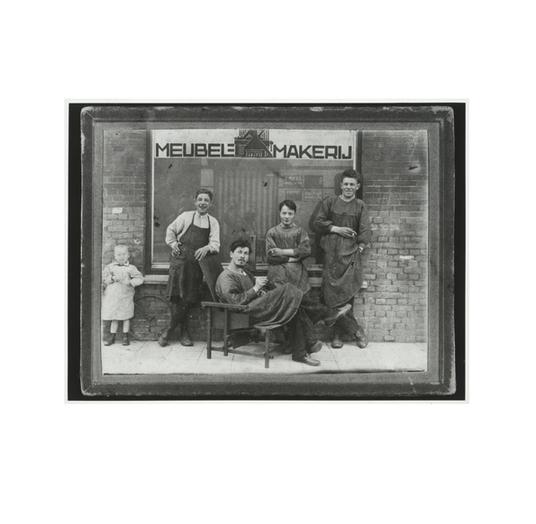
Gerrit Rietveld designed this chair in 1919 for a competition. It was intended to be a simple armchair costing less than 35 guilders. What began as an affordable chair grew over the years into one of the world’s most famous designs.
You might be wondering: where are the familiar colors? This first chair had no colours.

Only later does the chair acquire its distinctive colors: red, blue, black, and a touch of yellow.

“We must help simplify life, freeing it from excess.”
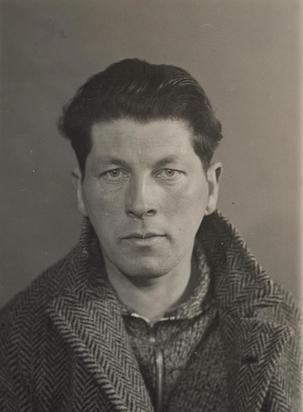


In 1987, students at the Gerrit Rietveld Academie in Amsterdam made dozens of 'crippled' Red and Blue Chairs in protest against cuts to arts education.

A man dressed as Prime Minister Lubbers makes short work of a Rietveld chair. This performance, too, is part of the protest against the looming budget cuts.

Claudia de Breij placed this chair, covered in news clippings, on stage during her 2019 New Year's Eve show.
To her, it symbolizes people who dare to break with convention—just like Rietveld.

The yellow looks green here: it is infected with a virus.
In this way, the General Idea art collective draws attention to HIV and AIDS, an illness that claimed the lives of two of the collective’s three members.
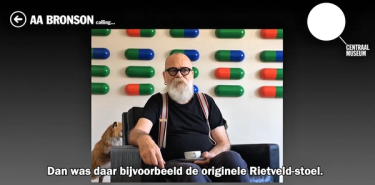
Artist AA Bronson explains why art collective General Idea chose to use a Rietveld chair.

To make something new, sometimes you first have to tear something down. In his Smoke series, Maarten Baas burned existing design classics. Rietveld’s chair, too, met the same fate.Was this an act of patricide, or was Baas creating a new icon?

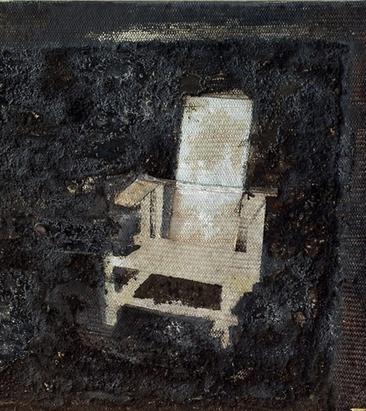
With ‘Nobody gives a shit about Rietveld in Mali’, artist Victor Sonna draws attention to precisely that issue. He created the work together with women from Mali using woven reeds.