Permanent exhibition in the Nicolaïkerk, next to the Centraal Museum.

Archive
Sculpture Before the Iconoclasm
The Nicolaïkerk, on the square next to the museum, houses a selection from the Centraal Museum’s collection of medieval sculpture. Until 1550, Utrecht was the largest city in the Northern Netherlands and had a flourishing tradition of sculpture. Much of Utrecht’s medieval sculpture was lost through iconoclasm, natural disasters and urban redevelopment. But much has also survived. Sculptures rediscovered later are now part of the Centraal Museum’s collection.
Utrecht, cultural centre of the Northern Netherlands
The dozens of churches, chapels and monasteries in Utrecht covered approximately one-third of the city’s territory. The old church buildings still bear witness to the prosperity and wealth the city once enjoyed. The episcopal see made Utrecht not only an ecclesiastical centre, but also a political and economic one. Owing to the Church’s prominent role, Utrecht was a flourishing centre for the decorative arts. Under Bishop David of Burgundy (1456–1496), artistic production reached its peak. The wealthy clergy, as well as noble families and affluent citizens, demonstrated their piety and social status through donations to the churches.
The Flourishing of Utrecht Sculpture
The fifteenth century was the Golden Age of sculpture in Utrecht. The influence of several exceptionally talented masters and their workshops can be seen throughout Europe. The most important masters were Adriaan van Wesel (c. 1417–c. 1490), Jan van Schayk (active c. 1494–1523), and an unknown artist known as the ‘Master of the Utrecht Stone Female Head’ (active c. 1490–1525). The flowing, slender style of the Gothic period is reflected in Utrecht sculpture from this era.
History of a Utrecht Parish Church
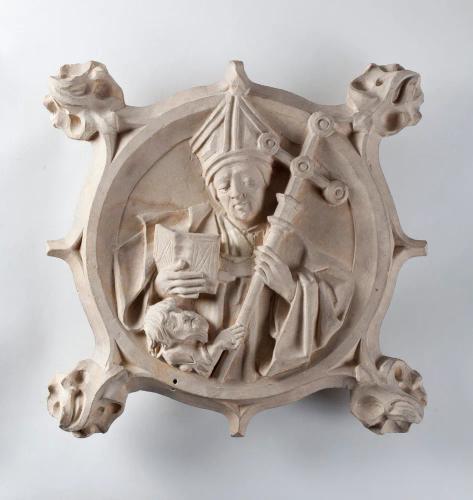
Alongside several remarkable late medieval sculptures, there are also objects on display that specifically relate to the history of the Nicolaïkerk itself, such as two beautifully decorated vault bosses dating from around 1470. There is also a gravestone belonging to the Brotherhood of St Anthony, which was affiliated with the church in the late Middle Ages. To give an idea of the kinds of small devotional statues parishioners often owned themselves, a pipe-clay figurine of St Catherine of Alexandria is on display, together with the moulds in which it was made. In the late Middle Ages, Utrecht was an important production centre for such inexpensive figurines, and many of the moulds used to make them were discovered in 1844 during the demolition of the city walls.
Visitor information for Nicolaikerk
Nicolaaskerkhof 8, Utrecht
nicolaikerk.nl
- Title
- Beeldhouwkunst voor de Beeldenstorm
- Exhibition start date
- 11 May 2007
- Exhibition end date
- 20 May 2025
- Location
- Nicolaïkerk (Utrecht) (tentoonstelling voor onbepaalde tijd.)
- Documentation
- Beeldhouwkunst voor de beeldenstorm, tekst Alice Taatgen, Renger de Bruin, Centraal Museum (Utrecht, 2007), [8] p.
- Sculpture prior to the 'Beeldenstorm', text Alice Taatgen, Renger de Bruin, Centraal Museum (Utrecht, 2007), [8] p.
Collection in this exhibition


Featuring work by
Anoniem Maastrichts (?), Anoniem Rijnlands, Anoniem Utrechts, Anoniem Utrechts (?), Anoniem Westfaals, atelier Meester van de Utrechtse Stenen Vrouwenkop, Schayck Jan van (van Scayk) (?)
Centraal Museum
Look closer, see more