The Future of Fashion Heritage Is Digital

29 Apr 2022
In 2022, the exhibition From Pattern to Polygon was on display, an impressive presentation in which historical costumes were brought to life through enchanting animations, augmented reality and other digital techniques.
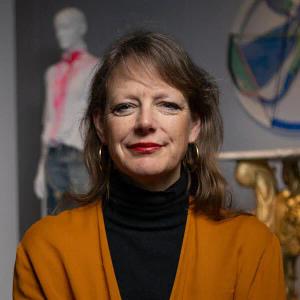
In this article, curator Ninke Bloemberg provides concrete examples of how the physical and digital design worlds come together and enhance one another.
Hidden gems
The fashion and costume collection comprises more than 10,000 garments and accessories: an inexhaustible source of inspiration for exhibitions, research and knowledge exchange. From 17th-century pattens (shoes) to a 3D-printed dress by Iris van Herpen, and from 18th-century gowns to a three-piece men’s suit by the recently deceased top designer Virgil Abloh. Part of the collection is on display in exhibitions, but the vast majority is kept in storage. While a museum can display paintings permanently, textiles are too fragile to be exposed to the conditions of a museum gallery for extended periods. Digitisation therefore offers a tremendous opportunity for fashion heritage.
The two-piece gown, as pictured in a 1947 museum catalogue, p. 47.
The Costume Collection, 1750–1930. Guide and Catalogue 1947
Take, for example, this two-piece gown from 1892, donated to the museum in 1937. Some designs simply exude elegance, and that is certainly true of this creation. The subtle decoration of floral tendrils and bows in gold thread, sequins and tiny pearls on warm yellow silk satin is the work of the Belgian fashion house Madame van der Taelen, which operated ateliers in Brussels and Ostend.
Elise van Ittersum (1851–1936), lady-in-waiting to Queen Emma, wore this gown in 1892 to a reception at Soestdijk Palace. As a scion of an old baronial family from Overijssel, Van Ittersum knew exactly ‘what was proper’, and she undoubtedly made a successful entrance in this elegant design.
Research for the exhibition Out of Fashion (2017) revealed that the ravages of time have damaged the fabric of the gown to such an extent that it can no longer be restored, let alone displayed on a mannequin or torso.
What was the problem? In the late 19th century, it was common practice to weight silk: metals were added during the production process to make the fabric stronger and thicker. This not only gave it a richer appearance, but also meant that a higher price could be charged for the fabric, making it economically attractive. Now, more than a hundred years later, the consequences are severe: the gown has become extremely fragile, and the splits (small tears) in the fabric will only continue to increase. Unfortunately, this process is irreversible, making restoration impossible.
The combination of its unmistakable quality and the fact that we know who made and wore the gown makes its ‘rebirth’ in the digital world particularly interesting.
Costume show marking the 150th anniversary of the Centraal Museum in 1988.
Rebirth in the digital world
In 1988, the museum organised a fashion show. Models wore garments from the museum collection. As beautiful as it was, such a show would be unthinkable today. The risk to these fragile pieces is simply too great. Today’s fashion show is digital. Studio PMS has brought life and movement back to this ‘static’ garment. In From Pattern to Polygon, you can see the gown ‘walking’ in a digital catwalk show, accompanied by a Bas Kosters outfit and a turquoise evening gown, among others.
Studio PMS, exhibition of digitised objects from the fashion collection, 2022.
Multidisciplinary artist David Willems offers a highly personal interpretation of Madame van der Taelen’s gown, displayed a little further on in the exhibition. He brings movement to the fabric, transforming its embroidery and textures into lifelike plants and animated creatures. His work treads a fine line between realism and abstraction.
David Willems, variation on a two-piece gown from circa 1892, 2022.
Craftsmanship in the 21st Century
Anyone who thinks that making the transition to the digital world can be done at the touch of a button is in for a surprise. The exhibition offers a behind-the-scenes look at digital design, a world of ‘particle distance’ and rendering hours. While a traditional fashion designer spends hours drawing patterns, draping (arranging fabric on the body), sewing invisible zips or stitching embroidery, digital design also involves many hours of thought and computer work: the way fabrics fall must be adapted to the avatar (the virtual wearer), while materials must be given thickness and the correct prints, sheen, embroidery and trimmings, using polygons—multi-sided geometric shapes that make 3D digitisation possible. Every adjustment requires a time-consuming recalculation. Making a highly detailed design move for just three seconds takes the computer no less than 48 hours of processing, a process known as ‘rendering’.
What is ‘real’?
For this exhibition, Studio PMS and the museum collaborated with a new generation of designers. They go one step beyond the digital catwalk, reconstructing a garment from the fashion collection and transforming it through animation, digitisation, virtual reality and 3D modelling.
These technological developments cast the concept of ‘real’ in a new light, as a parallel world. A new generation of creators has emerged, exploring this issue in their own unique way. Below are several applications featured in the exhibition.
An NFT with a weather forecast
Especially for From Pattern to Polygon, Stephan Duquesnoy created the very first NFT in a Dutch museum collection. NFTs, or digital certificates of ownership, have significantly boosted the rise of digital fashion over the past year. A turquoise gown with gold lace, designed around 1905 by Madame van der Taelen, was worn by Henriette van der Poll, lady-in-waiting to Queen Emma. Studio PMS digitised the gown, after which Stephan Duquesnoy transformed it into a digital artwork.
What is unique is not only the collaboration between the museum, Studio PMS and Duquesnoy, but also the fact that the NFT links to KNMI weather reports from 1905. Thanks to a continuous live update, the image changes constantly based on the light, weather conditions and time of day during that year.
From virtual to reality
Utrecht-based fashion designer Tess van Zalinge places craftsmanship and tradition in a contemporary context in her collections. Influences from Dutch heritage, combined with the reuse of materials, form her crystal-clear signature. Van Zalinge’s new collection Natuurlijk explores the paradox of ‘untamed’ nature, which is increasingly being protected and cultivated. She asked Studio PMS to use its own creative vision to design the eighth look for her latest couture show on the computer, inspired by the seven other creations in Natuurlijk. Despite their entirely different approaches, the studios share a love of craftsmanship and innovation, as well as a sense of urgency around sustainability. Studio PMS created a meticulously detailed digital design, rich in detail, texture and colour. Van Zalinge then transformed it into a physical garment using a wide range of textile techniques, reused materials and hours upon hours of handwork. In effect, there are now couture designs 8a and 8b: one virtual and one real. This is how 21st-century crafts merge.
Virtual fitting room
You can wear pieces from the museum's fashion collection again! Not physically, of course, but virtually. In From Pattern to Polygon, visitors can try on unique Dutch designs and 19th-century men's shoes in a virtual fitting room. Especially for the exhibition, Amsterdam-based FloatScans experimented with shoes from various periods. Step into the shoes and take a step into the future of our fashion heritage.
What's next?
For From Fit to Polygon, Studio PMS and other creators meticulously and respectfully reconstructed several fragile designs from the museum as high-quality digital (catwalk) models, and even created new works of art. The exhibition forms the ultimate bridge between past and present and marks the beginning of the further digitization of fashion archives in Dutch museums. The online platform Modemuze —a collaboration between several museums with fashion collections—is leading the way in this initiative.
In this way, the Centraal Museum's fashion collection serves as a source of inspiration for a new generation of designers and projects.
Read more