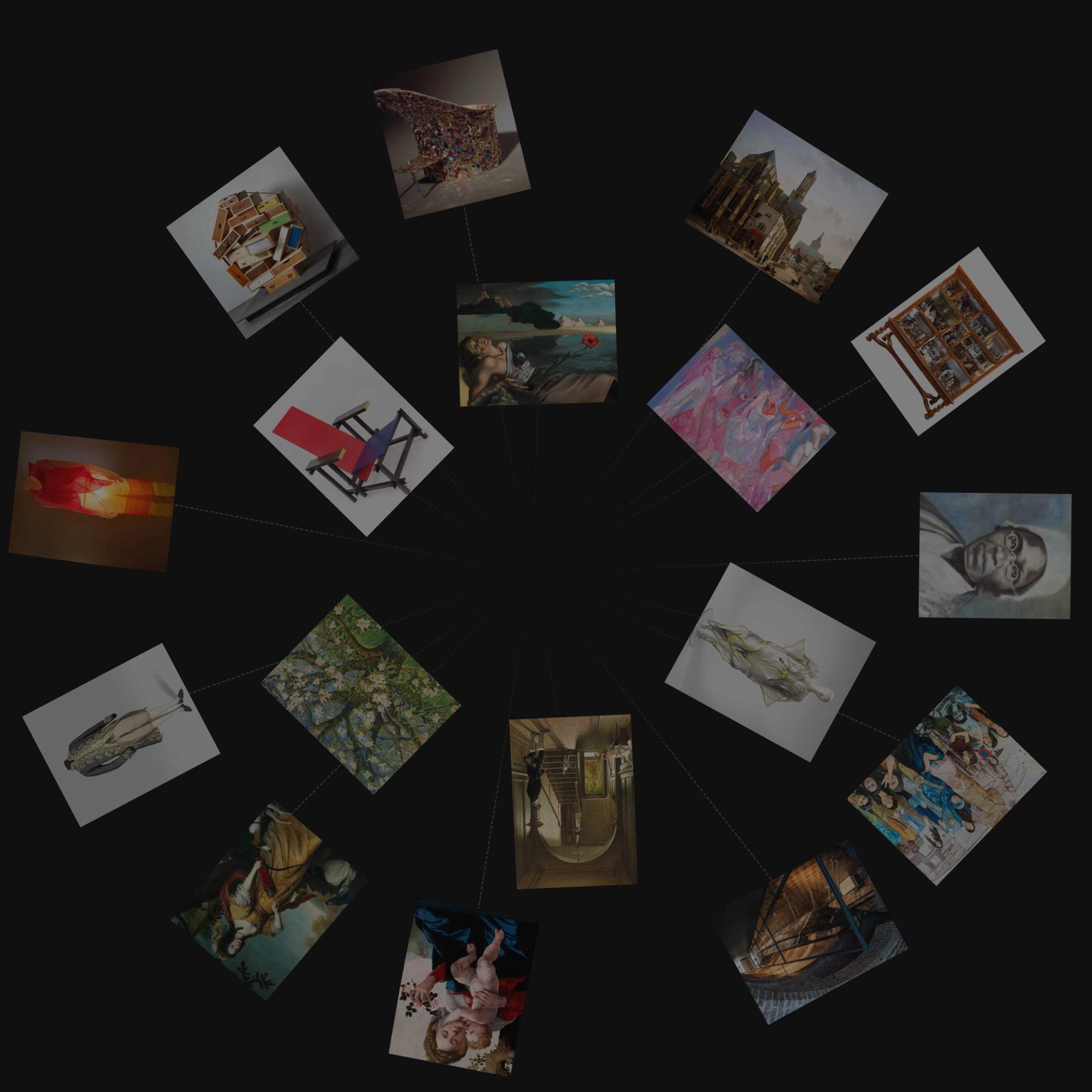
Mothering Myths
Mothering Myths is the English-language publication accompanying the exhibition Good Mom / Bad Mom. This article is the book’s introductory essay, written by the exhibition’s curators, Laurie Cluitmans and Heske ten Cate.
Visit the exhibition
An exhibition about motherhood, caregiving, the politics of the womb, and emancipation.
A beginning
“All birds have begun building nests, except me and you—what are we waiting for now? ”
For a long time, this sentence was regarded as the oldest surviving written sentence in Old Dutch. A scribbled note reflecting on starting a family, filled with doubt and uncertainty—still just as relevant 1,000 years later. It is a fragment that touches on the very essence of life, on the dilemma every person faces at some point: do we want to form attachments, commit, nest, give birth?
A Flemish monk probably wrote down this phrase in 1075 in a monastery in Kent. Not with the intention of making history, but to test a new pen before continuing to copy a Latin manuscript. Not a monument of great historical significance, but an everyday scribble: the lyrics of a folk song sung by women. At the time, the act itself mattered more than the meaning.
The marginal scribble Olla Vogala transformed 100 years ago into a symbol of the identity and origins of a culture—no less than 900 years after it was written down. It illustrates the way history is constructed: we rarely recognize it while it is being lived, and only in retrospect does it acquire meaning. This is hopeful, and the reason for beginning this introductory essay to the book Mothering Myths in this way. For does the same not apply to the story of The Mother[1], who occupies no more than the position of a meager marginal note in the sidelines of Western art history?
Virginia Woolf wrote: Just consider: it's the beginning of the twentieth century, and until a few years ago no woman had ever come out by herself and said things at all. There it was going on in the background, for all those thousands of years, this curious silent unrepresented life.[2] Woolf is referring to all those women who remained inside their homes, behind closed doors, caring for home, hearth, and children. Who sees their lives? Who tells their story, their place in history? Why are their lives not important enough to be discussed and preserved for the future?
Cover of the book Mothering Myths
History is only his story
“Psychoanalysis focuses so intently on the child's development that the mother, in her paradoxical state—created by the child but existing apart from it—can never be the central character. [3]”
In her extensive art project Mothernism (2014–present), artist Lise Halle Baggesen describes a black hole in art history. There has been room for every theme: life, love and death. But creating life and caring for it seem to have disappeared into a ‘mother-shaped hole’. When you consult the major standard works of Western art history, ‘motherhood’ appears to be embodied primarily by one woman: the Holy Virgin Mary, serenely, tenderly and lovingly holding the Son of God (often depicted far more prominently): in her arms, at her breast, or later in her life, dead in her lap. One could argue that even she, depicted so often and so iconic, is merely a flat character in a larger story that is not about her, nor about all the joys and vagaries of parenthood.
“Mary is the virgin, the woman without sin, the nun-woman, the anti-Eve.[4] ”
In the religious Middle Ages, it was clear to everyone that, according to the Church, the fallen Eve embodied the image of woman. A woman punished with the pains of childbirth for making her own choices in life. The symbol of the degenerate woman. Mary, devoted to the life of the child, represented the higher yet unattainable ideal. Art critic Hettie Judah, however, describes how, as early as the 17th century, artist Artemisia Gentileschi managed to give Mary greater soul and depth: her breasts subject to gravity and engorgement, her gaze not merely serene but also concerned, and her hands not serving, but engaged in lively interaction with a restless child.[5] Moreover, this child was not depicted as a miniature adult or little old man, but as a real baby. Was it because Gentileschi herself gave birth to children, cared for them, and at a young age endured the heartbreaking loss of four of her five children that her depictions of the Virgin are not immaculate, but come closer to the reality of motherhood?
In her introduction to Representing Women, Linda Nochlin writes: Woman cannot be seen as a fixed, pre-existing entity or frozen ‘image’, transformed by this or that historical circumstance, but as a complex, mercurial and problematic signifier [...] the term ‘woman’ fights back, and resists attempts to subdue its meaning or reduce it to some simple essence, universal, natural and above all, unproblematic. [6]
We could replace ‘woman’ with ‘mother’, because although motherhood and womanhood are by no means synonymous, historically, women have long been associated with bearing children, and their fertility was their greatest asset. A woman was only seen as a ‘real’ woman once she had given birth to children.[7]
We can also say of the mother that she was seen as ‘essential, universal, natural, and unproblematic.’ The mother figure, and her representations throughout art history, are therefore infinitely more complex than the standard narrative would have us believe. This brings us back to Olla Vogala, the oral tale that was accidentally immortalised in ink. The story of The Mother is above all an oral and monolithic one, with no central place or roots in historiography, and as a result it never transcends the individual. Rosemarie Buikema, Professor Emerita of Gender Studies at Utrecht University, writes about this in her essay for Mothering Myths: Within the patriarchal order, there is no genealogy from mother to daughter, no progress or development symbolising transitions in the position of motherhood. Within that framework, the appearance of the female subject in the public sphere therefore always remains an incident, a deviation from the norm to be ignored or demonised.
Standard art history texts, such as those by Gombrich and Janson, may mention depictions of the Virgin and Child, but always from the perspective of composition, colour and light. Even in the free-spirited world of modern art, motherhood, parenthood and caregiving were not considered themes worthy of great, serious art. When we examined the Centraal Museum’s collection, our initial search mainly yielded works featuring the conventional depiction of the Virgin and Child. But when we viewed the objects through the lens of motherhood, we discovered there was much more to explore. One example is The Adoration of the Shepherds, painted by Johan de Veer in 1650. The title of this painting refers to the male visitors who came to see the newborn Jesus. Yet Mary and the three women who feature much more prominently in the scene are not mentioned. These women may have been patrons or midwives—something that has yet to be investigated.
The biggest myth
A mother’s work is invisible, undervalued and underpaid. Much like the work of many artists. And when the two come together, it becomes an even greater struggle. For a long time, it was believed that art could only be made if caregiving and creating were kept completely separate. The maxim imparted to female artists at art school—though to a lesser extent, it still is—is that being an artist and being a mother demand so much of a woman that the two cannot be reconciled. It is the great myth of motherhood in the visual arts.
That myth gave rise to the so-called mind-baby problem that Julie Philips describes in The Baby on the Fire Escape. How can you care and create at the same time? In an empathetic, non-judgmental way, Philips traces the many prejudices faced by authors, thinkers, and artists who are mothers. Writers and artists describe their mothering experience as ‘divided’. Mothers who also want to work face an internal struggle (shame, a sense of loss, guilt) and, on top of that, are publicly condemned as ‘bad mothers’. In the literature, for example, the Dutch painter Charley Toorop was invariably portrayed as a bad mother. She was said to put her painting and career before her children and family; despite living in poverty, she still allowed herself the luxury of nannies (rather than caring for her children herself); she entrusted the care of her daughter to her strict Catholic mother; and whenever she did act as a mother, she was considered too domineering. These forms of criticism can be traced back to Rousseau’s invention of the ‘good mother’ in the eighteenth century. A woman’s natural role is motherhood; the good mother devotes all her time to caring for and raising her children. It is her instinct and her duty to society. In return, she can count on society’s appreciation for fulfilling that maternal role. Opposite her stands the ‘bad mother’: the woman who also thinks about herself, or about things other than her child.
Contemporary artists, writers and thinkers call for space to acknowledge the lived experience and complexity of motherhood, while questioning the social system within which the role of the mother is defined and imposed. As Philips also points out in her book, writer- and artist-mothers continue to be criticised for the choices they made, while people rarely ask whether the great male painters were also fathers and, if so, whether they were good and caring ones. We can also approach Toorop more forgivingly and place her actions in their proper context. Above all, Toorop was a woman who struggled to reconcile her own artistic aspirations with caring for her children, as she reveals in her notes. She was also a free-spirited woman who, in the early twentieth century, made the exceptional choice to pursue a career as a painter. Despite a difficult marriage to an addicted and violent man—who destroyed her work during drunken rages—she tried to keep her head above water while caring for three children. In ‘Self-Portrait with Three Children’, she is the family’s defiant leader, paintbrush at the ready: a mother standing up for her children, together forming a united front.
For artist Tala Madani, too, the dogma of the “bad mother” prompted reflection. When Madani returned to the studio after maternity leave, she painted a Madonna: a mother and child. The image startled her. With such a saccharine scene, she would not be taken seriously as a young mother and painter. She smeared the still-wet image together. When she returned to her studio the next day, Shit Mom had been born: the paint had blended into a brown sludge, mother and child had blurred, no longer possessing boundaries of their own. It was a depiction that resonated with Madani’s own experience of motherhood. Not a blissful bubble (or at least, not only that), but literally being covered in shit; the reality of broken nights; getting to know and raising a human being; fears and concerns for the child’s well-being—and then all that labor that goes unseen and unacknowledged. But above all, Madani argues, Shit Mom is not about whether you are a good mother, but about how we think about our mothers. How is it possible that a mother must meet so many demands and imposed expectations that she is doomed to fail from the outset and becomes the “shit mom”? The “shit” a mother is simply expected to take from her child, patiently and self-sacrificingly, is one thing. But what if that image is propagated and reinforced by society’s institutions?
Our last Taboo?
“It’s the most universal of relationships - most people on earth experience the dramas of love, care, inadequacy and separation between parent and child - yet one that theworld is often invested in denying. ”
Many artists in Mothering Myths describe feeling ashamed of subjects that had been relegated to the ‘women’s corner’. Works addressing these themes were labelled ‘frumpy’, ‘therapeutic’ and ‘womb art’. Such views, if one is not careful, become internalised, causing artists either to refrain from speaking publicly about the deeper meaning of their work or, if they did speak out, to have it dismissed as ‘women’s art’. In August 2024, an interview with Camille Henrot in The New York Times noted that her work explores ‘Our Last Taboo’. This headline seems to imply that the shame surrounding the subject of motherhood has discouraged artists from exploring it for centuries, for fear of public rejection. In our view, however, the taboo concerns its relative invisibility within art history, not the subject itself. After all, the ridicule and belittling of the subject did not prevent artists from addressing it throughout the centuries. Countless poignant, empathetic and sublime representations of motherhood are woven throughout art history. Yet they have not entered the collective consciousness and have instead become part of a blind spot. This is why, as Buikema observes, these representations have remained isolated incidents. From time to time, they were briefly allowed to become visible in art history, only to be swiftly ignored and even erased once again. Consider, for example, Gentileschi, who is primarily interpreted as the young woman who takes revenge in her paintings on the man who sexually assaulted her, in works such as Judith Slaying Holofernes. Not as the artist who portrays motherhood with such tenderness.[8]
This also means that forms of mothering carry a much more profound and broader meaning beyond giving birth. Historically, there are numerous images that offer a layered reading of the mother's position. For alongside depictions of the Virgin and Child, there was also, for example, the motif of Our Lady of Mercy. In this representation, Mary wears an enormous cloak beneath which she offers protection to large groups of people. Here, Mary appears as a much more active and powerful figure, with not only her own child but throngs of people, children and those seeking comfort taking refuge with her. Our Lady of Mercy takes a much broader view of motherhood: she cares for everyone who needs it, not just her ‘own’ ‘biological’ child. And although this cloaked figure of mercy may seem to have been forgotten, she still lives on in our language. Both 'the cloak of love' and 'mantle care' refer to this form of ' mothering '.
A more contemporary example is the artist Aline Thomassen. Following the stillbirth of her first son, for instance, she created a series of paintings. She addressed that traumatic event in a series of life-size watercolours: a would-be mother, larger than life, positioned at the centre and surrounded by a universe of sleeping foetuses, their umbilical cords connected to her heart. They are moving, disarming, painful works that cannot be ignored. Yet for a long time, critics and curators failed to acknowledge the theme of this profound loss in her work. It was a story that was only allowed to exist in her private world and had no place in the public realm of visual art.
Moreover, it is impossible to consider that historic struggle for emancipation without taking the colonial past into account. In her video work Ulishiyele bani ibele from 2022 (English translation from isiZulu: who did you leave the breast for?), artist Buhlebezwe Siwani shows, in a restrained yet charged manner, how enslaved Black women had no right to their own bodies, fertility, or even children. The isiZulu phrase refers to an older child who must give up their mother’s breast for a younger child. In the context of Siwani’s work, it also refers to the woman who was forced to bear and relinquish children, like a factory.
The way things are
In Feminism and Motherhood, Susan Griffin asks: Why is it in the case of women that we always blame the individual and not the social structure. That we see failure in discrete lives and do not question “the way things are”.[9]
To understand Mothering Myths, we need to discuss not only visibility (in the visual arts), but emancipation as well. Because although we have made progress in terms of emancipation, there is still a long way to go: whose emancipation are we actually talking about? When women gained greater access to the labor market, the household did not become emancipated along with them. The idea was that care and household tasks would automatically be divided more equally between partners once women began working more outside the home. Countless books appeared on Why Women Work Less, offering hopeful recommendations such as free childcare, longer paid parental leave, and greater respect for household tasks. These analyses were not wrong, but they applied only to a specific class of women. They usually took the position of highly educated white women as their starting point. After all, to whom is the housework outsourced? As bell hooks writes, there are ‘many women of color, working-class women, and single mothers who dreamed of being able to stay home with their children.’ They did not work outside the home because they aspired to or wanted to, but because they had no other choice. Such low-paid, low-status work could hardly be called emancipatory.[10] Both historically and statistically, it can be shown that outsourced care work almost always falls on the shoulders of women—who are then paid little or nothing for it and occupy a more precarious position in society. At the same time, another question arises now that right-wing politicians are once again condemning women without children as ‘childless cat ladies’ who have no stake in society’s future. The emancipation issues of the 21st century therefore center on these questions: who must provide care, and who is allowed to provide care? And how can we revalue care work as an inherent and important part of society?
Mothering Myths therefore also needs inspiring and hopeful visions of the future in which all these positions can coexist. Take, for example, Amakaba by Tabita Rezaire. In the Amazon rainforest of French Guiana, she is creating a contemporary mantle of compassion: a healing center where spirituality and regenerative agriculture come together, where birth doulas are trained, and where ancestral knowledge serves as a powerful source for structures of communal living. Here, care for and with mothers is placed within the broader context of the lives of all living beings. Is this the village? Could this be it?
Endnotes
1. By mother, we mean anyone who mothers (described in the book under the entry (M)othering as: people with and without wombs, people who have given birth themselves and identify as a mother/father/parent. (M)othering involves providing emotional and physical care for another person and looks beyond the purely biological and legal aspects of motherhood
2. Virginia Woolf, The Voyage Out, 1915
3. The Baby on the Fire Escape, Julie Phililips, p. 5
4. Kraus, Henry, ‘Eve and Mary conflicting images of Medieval Women’ in Feminism and Art History, Questioning the Litany, Broude, N. & Garrard N.D. editors. 2018, Routledge New York
5. Hettie Judah, Acts of Creation; On Art and Motherhood, 2024. p. 95
6. p. 7
7. See, for example, the interpretation of Rousseau in the entry Good Mother (book Mothering Myths)
8. Judah
9. Griffin and Davey, p. 37
10. Meulenbelt, p. 25