A Journey Around the World in Eight Chairs
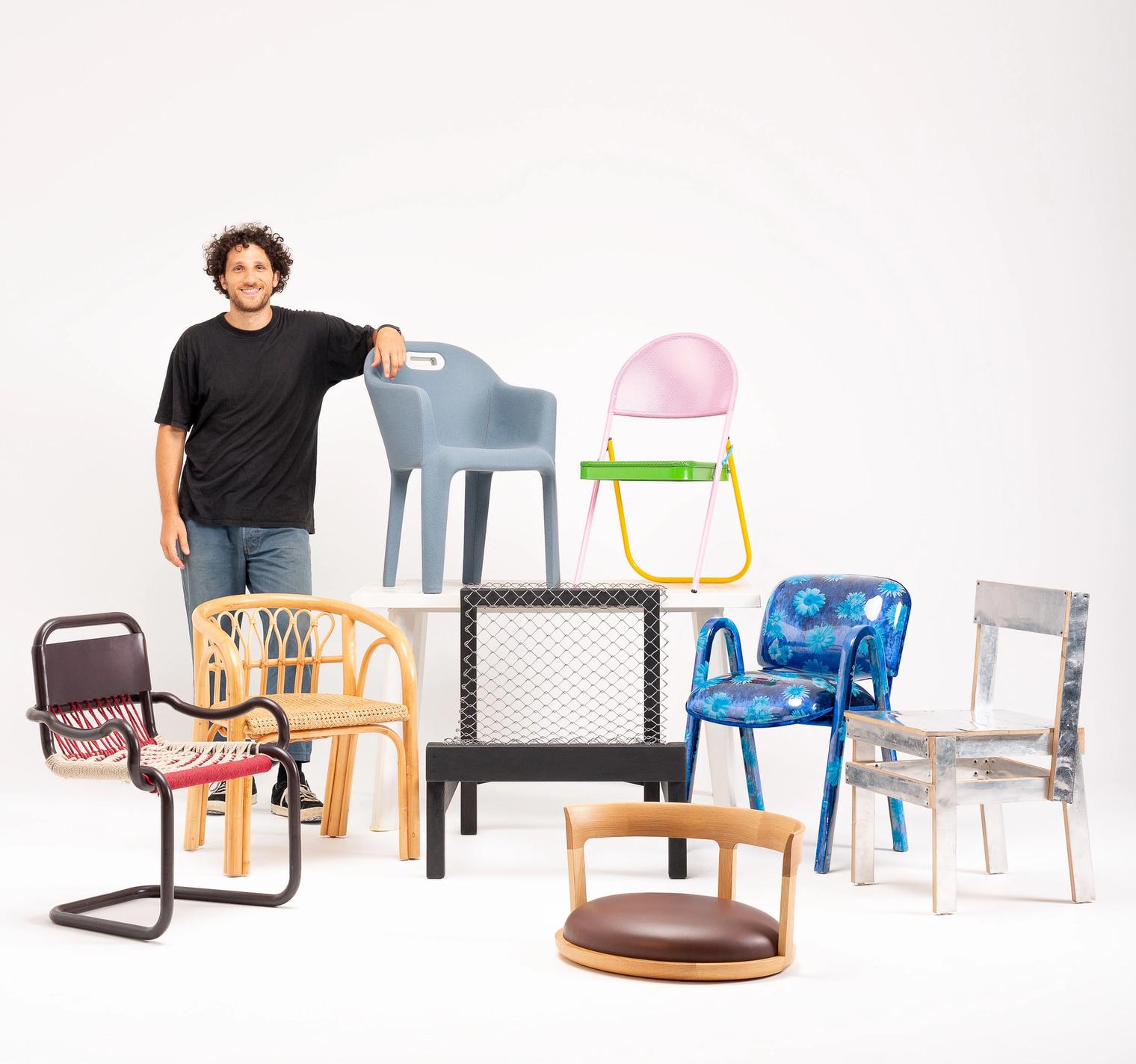
Can you portray a country through a chair? With his Cross Cultural Chairs project, Sicilian designer Matteo Guarnaccia made a surprising attempt to do just that. He travelled through the eight most densely populated regions in the world and returned with eight different chairs.
Cross Cultural Chairs
In the chairs, he incorporated the history, ideas, customs and traditions of people from different countries. By producing the chairs locally, he worked with local craftspeople, materials and production methods. The result is a unique series of chairs that is not only about design, but above all about people. This remarkable series was recently acquired by the Centraal Museum.
Sitting behavior
Are you reading this while sitting on a chair? Then you’re probably in a Western country. But if you’re squatting or sitting cross-legged, chances are you’re somewhere east of the Netherlands.
This is how Guarnaccia begins his story about the way our (sitting) behaviour is shaped by the culture around us. The way we sit has all kinds of practical consequences. If you sit cross-legged, you probably wear comfortable clothing too. And if you sit close to the ground, the rest of the interior will be adapted accordingly. Guarnaccia is interested in how sociocultural differences influence the design of everyday objects. And what everyday object is closer to us than a chair?
The Japanese chair.
Culture determines form
Guarnaccia started in Brazil and then travelled to Mexico, Japan, Indonesia, China, India, Russia and Nigeria. He followed one important rule: he would spend exactly one month in each country. During that time, the chair had to be both designed and made. As soon as he arrived, he raced through cities and villages, visited markets and museums, and discussed—sometimes using gestures—the residents’ customs and traditions, local politics and history. In this way, he quickly gained an impression of the country’s culture, while remaining fully aware of the limitations of his perspective as a (Western) outsider. Working with local designers, he then translated that impression into a design. Before the month was over, it had to become a real chair, complete with a photo shoot and presentation. After all, on the first day of the following month, the designer would fly on to his next destination. After eight intensive months, he returned with eight different chairs, each a portrait of a country.
Beach chairs and ice cubes
Guarnaccia documented his project in a video report – also held by the museum – and wrote a book about it. As you read and watch, you can travel alongside him, hopping on the metro and out of taxis. You join manufacturers at the table and get a glimpse over the shoulder of the local blacksmith. Following the designer through remote neighbourhoods, you smell, taste and wander along with him. He has a keen eye for even the most seemingly trivial details. You learn, for example, that the price of a beach chair in Brazil’s Ipanema rises in proportion to the number of ice cubes keeping the drinks cool. And that in Lagos, people spend an average of thirty hours a week sitting(!) in traffic, or that Russians like colourful plastic flowers to help them through the grey winter.
Making a chair with local designers.
Guarnaccia’s visits to craftspeople and manufacturers also yielded some interesting insights. The designer learned something new after every production run, but of course there was never a set formula. Every country has its own customs, time is a flexible concept, and drawings are not interpreted the same way everywhere in the world—it sometimes drove him to despair.
India
In each country, Guarnaccia asked everyone he met what they considered the country’s most typical chair. In India—where chairs were only introduced by the British—he came across a model made by the Indian manufacturer Godrej and Boyce. It turned out to have been inspired by a tubular steel chair by German designer Marcel Breuer. Guarnaccia incorporated his observation that many Indians sit with one knee drawn up by adding a curve to the armrest, making this posture more comfortable. The chair thus combines the Indian cross-legged position with the Western sitting posture. For the seat, Guarnaccia used the woven cordwork of the centuries-old Indian charpai.
The Indian Chair. Created in collaboration with Sameep Padora and Ajay Shah.
Brazil
The use of warm materials such as wood and leather is typical of Brazilian design. Even the name Brazil derives from the country’s national tree, the pau-brasil. In this chair, the leather has been replaced by an uncomfortable seat made of woven wire fencing. This refers to the policies and military stance of Brazilian president Jair Bolsonaro, who took office in 2019. According to critics, as president he would bring the country nothing but discomfort.
The Brazilian chair. Created in collaboration with Brunno Jahara and Dimitrih Correa.
Every chair has its own story
Ultimately, Guarnaccia consistently succeeds in combining stereotypes with his own unique perspectives to create a new and surprising piece of furniture. For the photo shoots of the chairs—for which he approached local photographers—he came up with a solution that was as simple as it was effective. To maintain a sense of unity across the widely varying locations, he used a distinctive piece of fabric as a backdrop each time. The fabric is often held up by people involved in the project.
More chairs in the Centraal Museum
The Centraal Museum has the largest selection of chairs by Gerrit Rietveld in its collection. From 23 September 2022, the Cross Cultural Chairs will be on display in the exhibition Chair Takes a Stand.
Fancy a sit-down?
Would you like to sit in a truly special chair? Visit Museum Café Centraal, where you can find chairs that are also part of the museum collection.